
Immigration attorneys are sounding the same warning to anyone with a case in progress: the Request for Evidence — the notice that once gave a filing a second chance — can no longer be counted on. More and more, they say, a case that isn't right the first time is simply denied.
Update, August 5, 2026: USCIS has now made this policy official. Policy Alert PA-2026-05 restores officers' discretion to deny a filing that omits required initial evidence without first issuing an RFE or NOID, effective immediately and including pending cases. Our full coverage of the alert is here.
What attorneys are reporting
Practitioners on opposite coasts have been describing the same thing, in their own words, from their own casework. Here is how a few of them are putting it to their audiences.
The warning that has traveled furthest comes from Jacob Sapochnick (@sandiegoimmigrationlawyer), who laid out the stakes he sees on adjustment cases in this reel:
I-130s and I-485s are now getting pure denials — no Request for Evidence. One missing tax return, outdated form, weak evidence, or simple clerical error = straight denial + NTA (Notice to Appear) in immigration court. Deportation proceedings can start immediately if you're out of status.
He isn't the only one. Shelle Simon (@simonsayslaw) put the same point in a single line: “no second chances for missing documents in your application.”
And Toland Law in Boston (@tolandlaw) described what they were seeing the same way:
USCIS is skipping RFEs and going straight to denial. One missing document. One weak piece of evidence. One bad interview. Case over — no second chance.
Why this matters
It is worth naming what the Request for Evidence actually did for the profession. It was never only a form. It was a review pass — someone reading the package closely enough to notice the missing page, and saying so before it counted. Where a practice leaned on “file it and see what they ask for,” part of its quality control was sitting on the other side of the desk.
If, as these attorneys are describing, that pass can no longer be relied on, the review does not disappear. It moves. It has to happen before the package goes out — on your clock, at your cost. That is the practical reason a second pair of eyes matters more than it used to: a small, avoidable mistake that once drew a follow-up request can now be the whole reason a case fails.
Where Lexfill fits
Lexfill runs two independent passes over a case before you file. Neither replaces an attorney's judgment. They exist so the ordinary, avoidable problems — the missing document, the clerical error — are surfaced while you can still do something about them.
Document intelligence reads every upload
When a client uploads a file, Lexfill reads the document rather than the filename. It identifies what the document is and sorts it into the right checklist slot, renames it to something a human can scan (Passport – Maria Alvarez – exp 2029-04-11), and pulls the details off the page: holder name, document number, issue and expiry dates, issuing country, A-Number, date of birth, address.
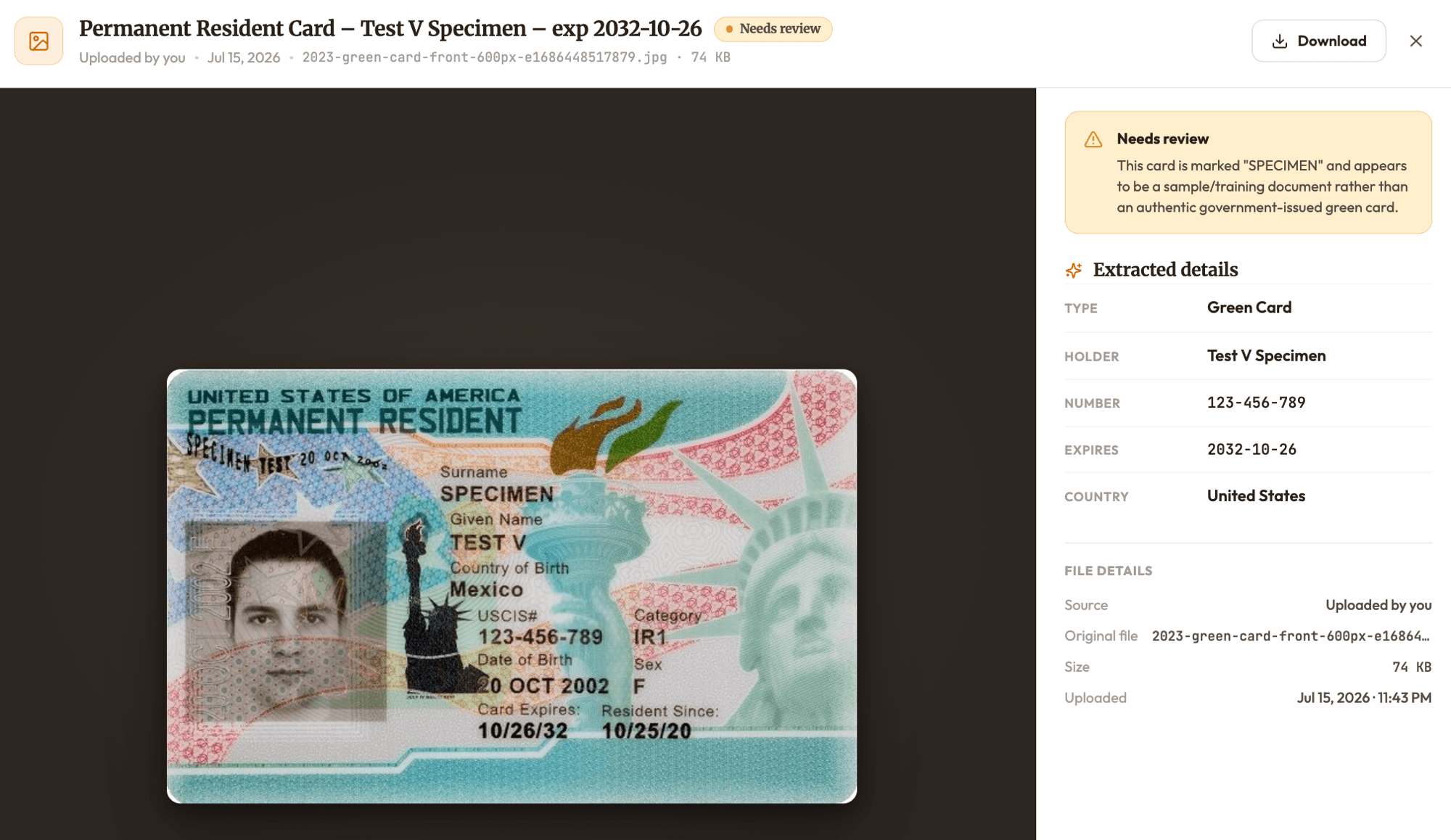
Then it flags what tends to cause trouble:
- Expired or expiring documents — anything already expired, or lapsing within six months.
- The wrong document in a slot — a birth certificate uploaded where the I-94 belongs.
- Name mismatches— when the name printed on the document doesn't match the name on the file.
- Scans you can't read — blurry, cropped, dark, or missing pages, caught at upload while the client is still paying attention.
What it extracts flows into the client profile and any form not yet started — but only into fields that are still empty. Lexfill does not overwrite what a person typed. Every value it fills carries a From document mark tracing back to the upload it came from, so nothing enters the file anonymously.
AI review reads every answer
The second pass sets the documents aside and reads what the client told you. It looks across the completed forms in a case for the contradictions that are easy to miss late in the day: dates out of order, employment or address histories with gaps or overlaps, a date of birth after the date of entry, a state entered where a city belongs, a ZIP that doesn't match its state — and the same fact answered two ways on two forms. A name spelled one way on the I-130 and another on the I-485. An A-Number off by a digit.
Each flag comes back marked critical, warning, or info, so you can triage rather than re-read. Edit the answer and the note becomes yours.
A human still signs off
Every upload sits as pending until someone on your team approves it. Reject one and Lexfill reopens the checklist slot and emails the client for a better copy. The software sorts, reads, and flags. The attorney decides.
Prepare as though there won't be a second look
That is the through-line in what these attorneys are telling their clients. The safest assumption is that a filing gets read once, exactly as submitted — so the mismatched A-Number, the expired passport, the answer that contradicts another form should never reach an adjudicator unseen.
Lexfill won't make the judgment call for you. It will help make sure that when you make it, you are looking at a complete file — the expired passport already flagged, the mismatched A-Number already surfaced, and every autofilled field traceable to the document it came from.