
A couple married six years. Joint lease, joint bank account, two kids. And USCIS still issued a Notice of Intent to Deny — not because of the marriage, but because of three months of address history. It's the kind of case story attorneys trade as a warning, and it deserves a close look, because the mistake behind it is one almost every busy practice could make.
The story
Immigration attorney Jacob Sapochnick (@sandiegoimmigrationlawyer) shared the case in his Instagram stories. In his words:

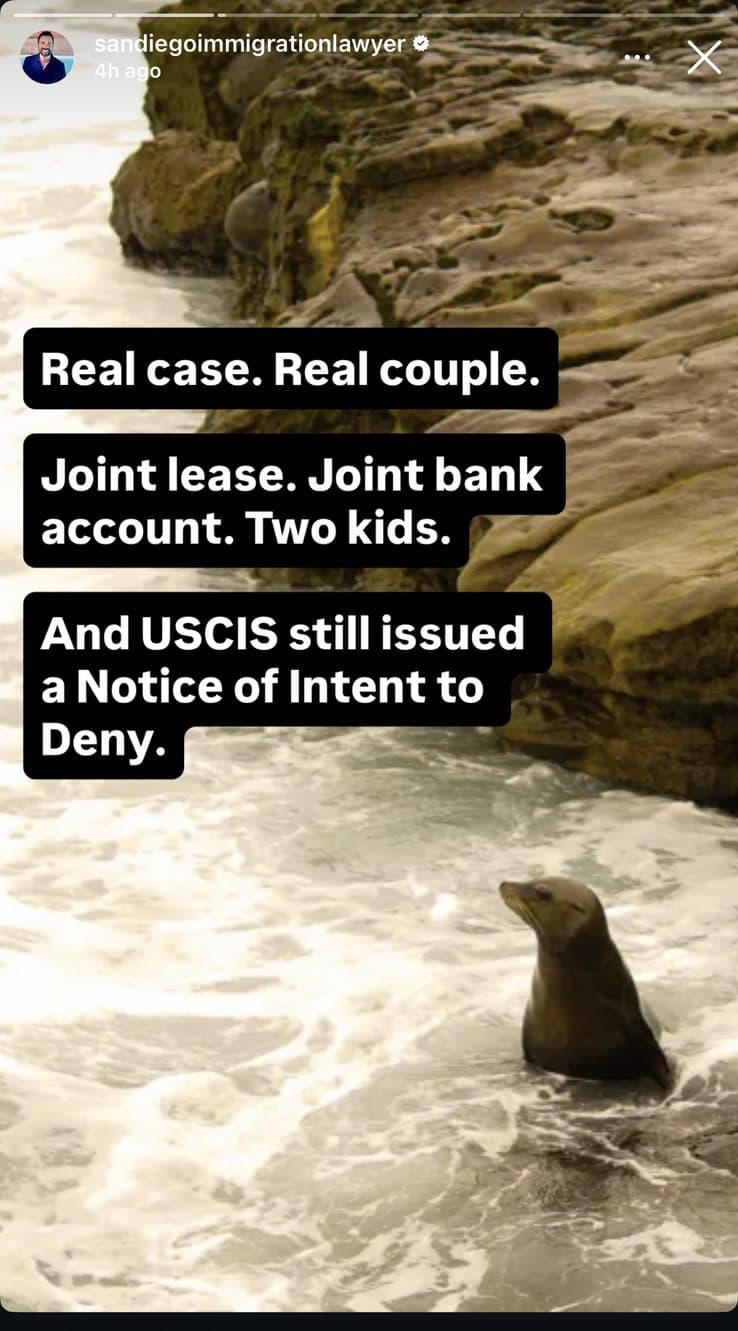
Real case. Real couple. Joint lease. Joint bank account. Two kids. And USCIS still issued a Notice of Intent to Deny.
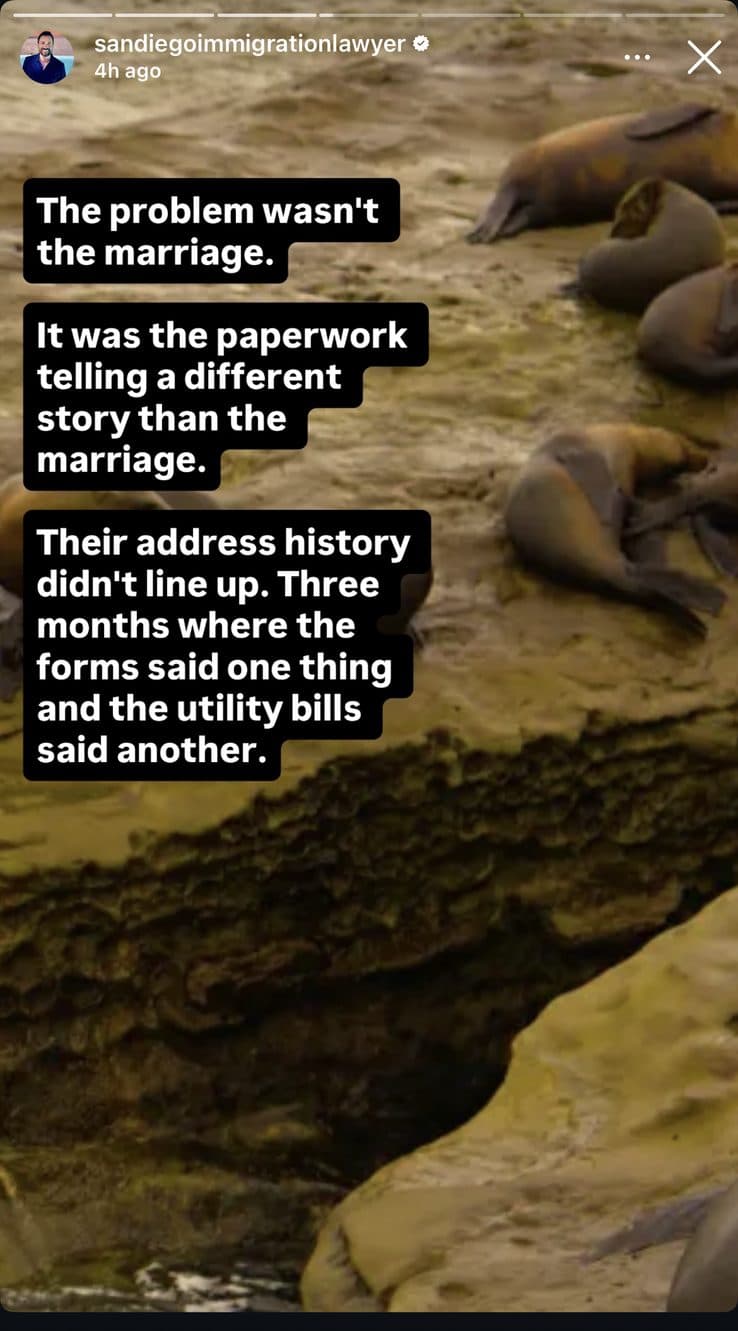
The problem wasn't the marriage. It was the paperwork telling a different story than the marriage. Their address history didn't line up. Three months where the forms said one thing and the utility bills said another.
And then the line that should stop every practitioner mid-scroll:
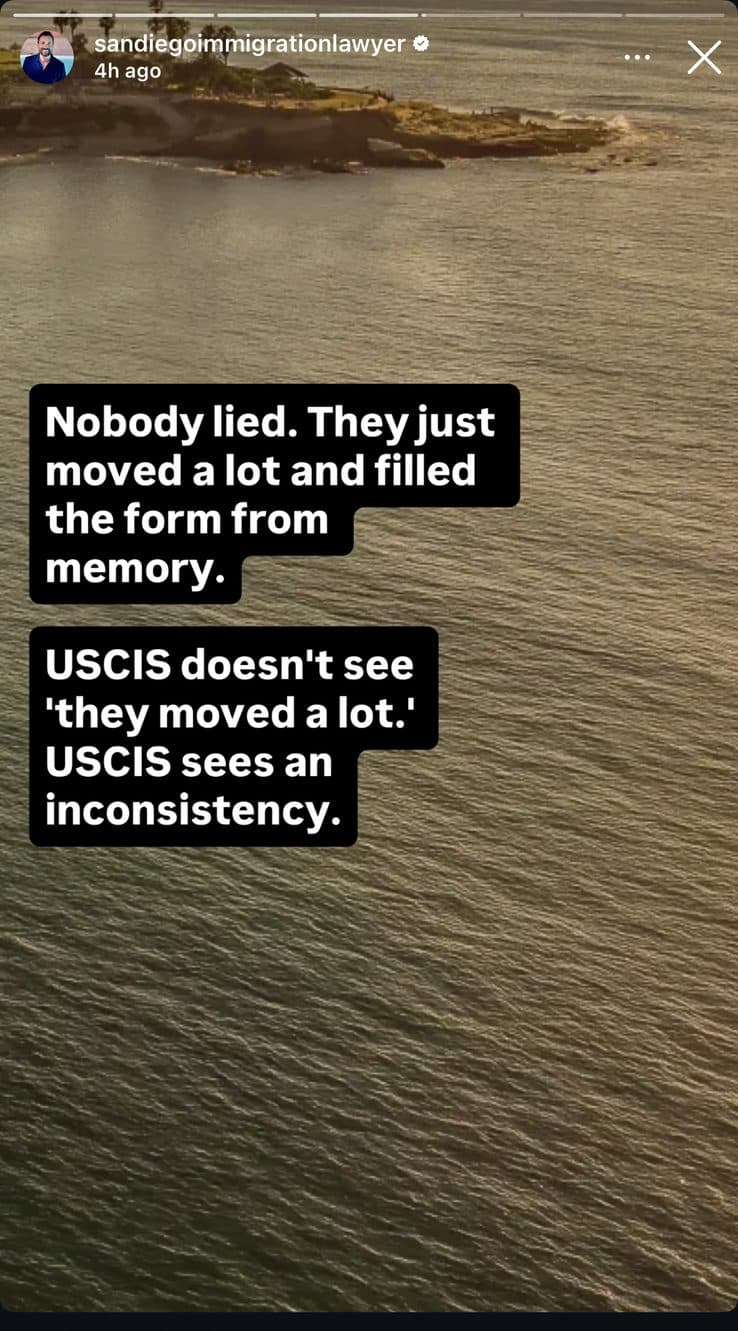
Nobody lied. They just moved a lot and filled the form from memory. USCIS doesn't see “they moved a lot.” USCIS sees an inconsistency.
Why this failure mode is so common
Address history is the perfect trap. It spans five years, it lives in the client's memory, and the evidence that contradicts it — leases, utility bills, bank statements — is generated by third parties with their own dates. A client who moved twice in one year will genuinely not remember whether the Chula Vista apartment ended in March or in June. They'll write down something reasonable, and it will be reasonably wrong.
The attorney's side of the trap is quieter: nobody re-reads every utility bill against Part 1, line by line, at the end of a long day. The form looks complete. The documents folder looks full. The mismatch sits in the gap between them — invisible until an adjudicator, whose whole job is cross-reading, finds it. As Sapochnick put it, USCIS doesn't see a family that moved a lot. It sees a petition whose own record disagrees with itself.
And as attorneys have been warning for months, the follow-up letter that once absorbed this kind of mistake can no longer be counted on. The cross-read has to happen before the filing goes out — on your desk, not theirs.
What catching it early looks like
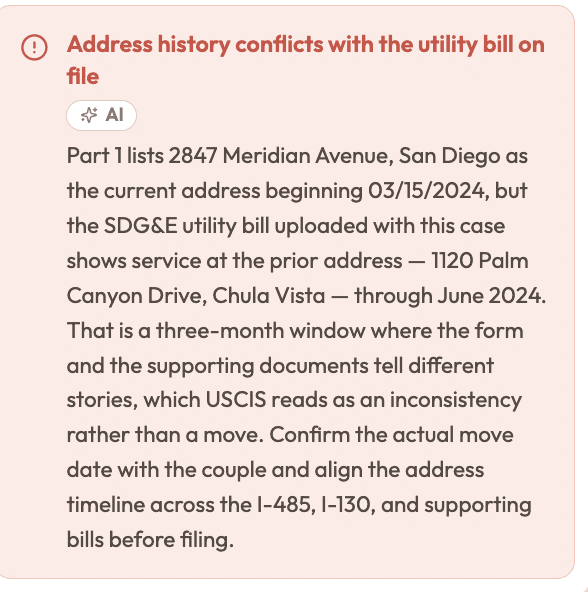
We rebuilt this exact scenario in Lexfill as a demonstration case: a marriage-based adjustment where the I-485 lists the current San Diego address starting in March, while the utility bill on file still shows the prior address through June — the same three-month window from the story. Here is what the attorney sees when they open the filled form for review.
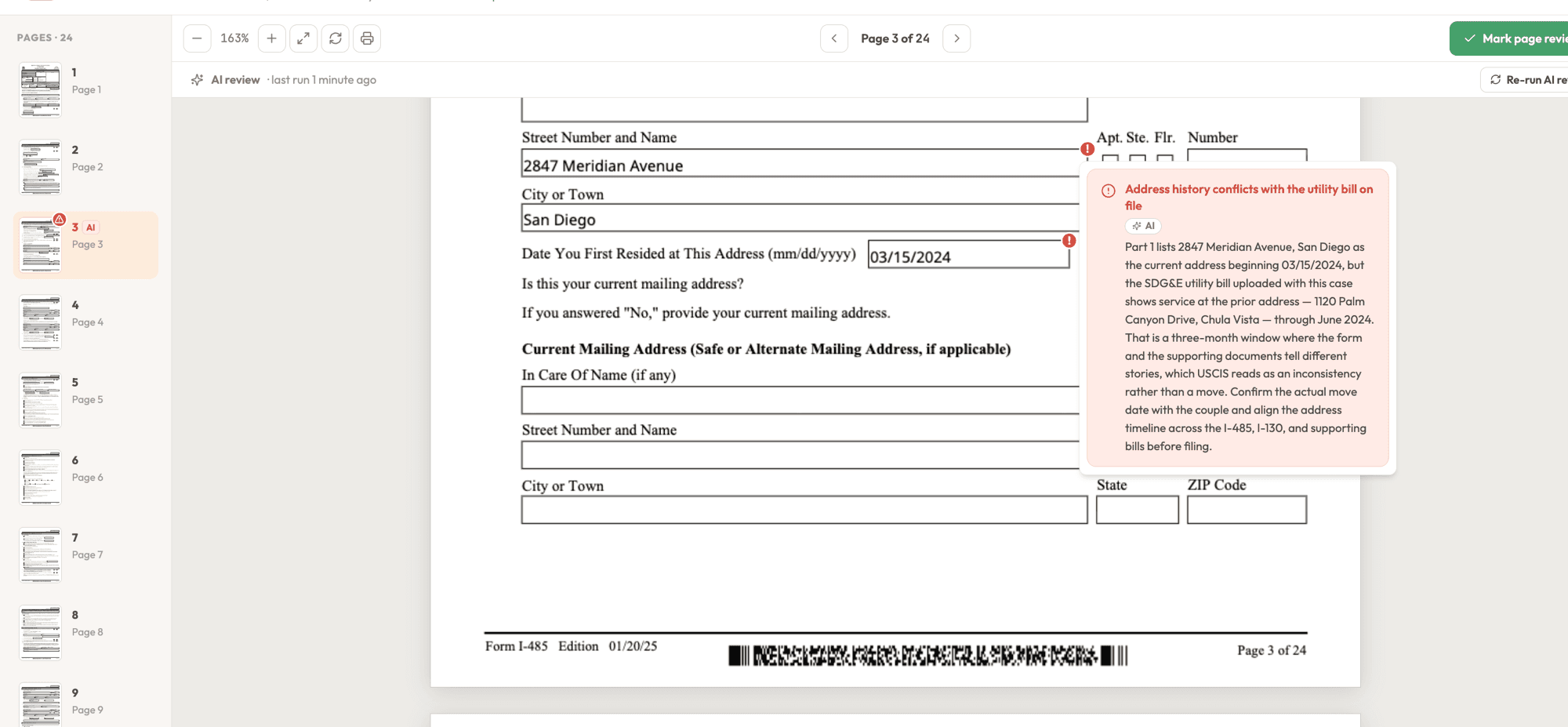
The note reads the way a sharp paralegal would put it in the file margin:
How the pieces fit
Nothing in that screenshot is a special feature built for address histories. It falls out of how a Lexfill case is put together:
- The intake is a conversation, not a packet. The client answers one question at a time, in their own language, and every answer is validated and dated as it lands — so the address timeline exists as structured data, not handwriting.
- Documents are read, not just stored. When a client uploads a bill or a lease, Lexfill reads it — what it is, whose name is on it, which address, which dates — and files the details alongside the answers.
- The review pass cross-reads the whole case. After the forms are complete, an AI review sweeps every answer across every form in the case, hunting for exactly this class of problem: dates out of order, histories with gaps or overlaps, the same fact answered two ways in two places. Each finding lands as a severity-ranked flag on the exact line of the actual PDF.
- A human still decides.The attorney clears the flag, edits the answer, or picks up the phone and asks the couple when they really moved. Edit the note and it becomes yours; the AI never overrides a human's call.
The review has to move upstream
The couple in Sapochnick's story had a real marriage and honest answers, and still spent months responding to a Notice of Intent to Deny — because the cross-read happened in an adjudicator's hands instead of their attorney's. That's the whole argument for moving the review upstream: the same mismatch, surfaced while the file is still on your desk, is a five-minute phone call. Surfaced after filing, it's a NOID response.
Lexfill won't judge whether a marriage is bona fide — that's your job. It will make sure that when the file leaves your office, the forms and the documents are telling the same story.